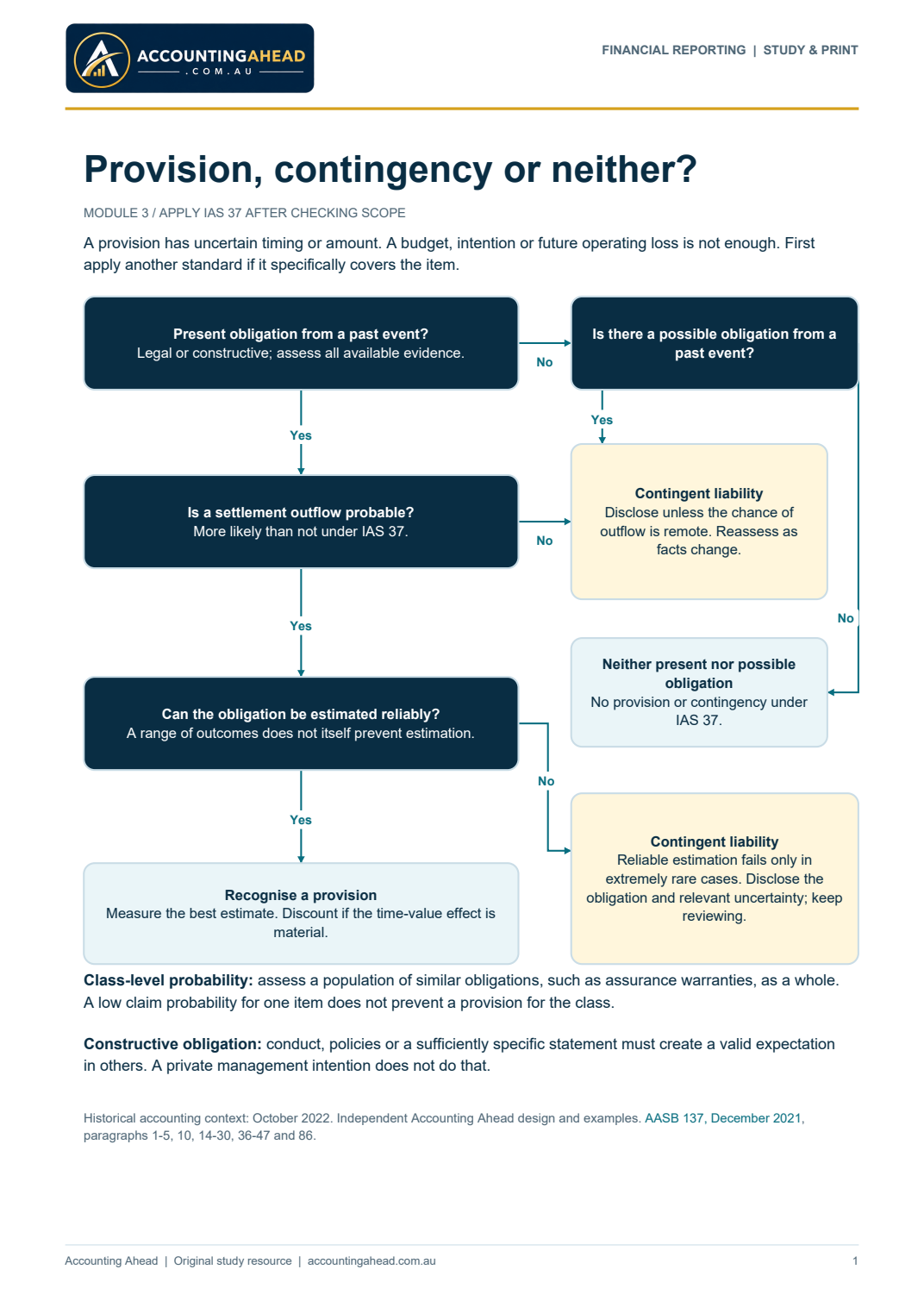
A provision is a liability with uncertainty about timing or amount. It is still a liability, not a separate category outside liabilities. Trade payables and accruals usually have less uncertainty; expected credit losses and depreciation allowances are not IAS 37 provisions merely because people sometimes use the word 'provision' informally.
Before applying IAS 37, check whether another standard addresses the item: examples include employee benefits, income tax, financial instruments, leases and particular business-combination obligations. Ordinary executory contracts are generally outside IAS 37 unless onerous. A large planned expenditure is not automatically an existing liability.
Has something already occurred that leaves no realistic alternative to settlement?
Contract, law, relevant conduct and communications
Probable outflow
Is settlement by an economic-resource outflow more likely than not?
Claims information, expert advice and relevant experience
Reliable estimate
Can a sufficiently reliable estimate be made?
A supportable range, probabilities and measurement method
All gates must be satisfied. A remote outflow is not made probable by choosing a small expected amount. Equally, uncertainty about the exact payment does not make a reliable estimate impossible. Inability to measure sufficiently reliably is extremely rare.
For a large class of similar obligations, assess the probability of outflow for the class as a whole. Even if an individual product is unlikely to fail, it may be probable that the warranty population will require payments. Recognition and measurement are separate decisions: first establish that a provision belongs in the accounts, then estimate its amount.
A legal obligation can arise from a contract, legislation or other operation of law. A constructive obligation depends on the entity's conduct creating a valid expectation in other parties that it will accept a responsibility. An internal intention or a wish to appear responsible is not enough. Identify what was communicated or established, to whom and before which reporting date.
Future operations can be changed to avoid some costs. A planned staff training programme or future advertising campaign is normally not a provision for costs already owed to others. Costs arising independently of future conduct, such as an obligation to remedy existing damage, need a different analysis.
Sometimes it is unclear whether a past event created a present obligation. Consider all available evidence, including expert opinions and later information that clarifies conditions at the reporting date. If a present obligation is more likely than not, apply the remaining provision gates. Otherwise consider a contingent liability, unless the outflow possibility is remote.
A claim letter does not itself prove liability, and management's confidence does not settle the matter. Record the event, the evidence supporting and contradicting an obligation, the estimated outflow and the reporting-date conclusion. Separate new events after the reporting date from later evidence about existing conditions, using the subsequent-event principles studied in Module 2.
An assurance warranty promises that a product meets its agreed specification. It generally produces an IAS 37 obligation when the relevant products are sold. A service warranty provides something additional and may be a separate IFRS 15 obligation. If assurance and service elements cannot reasonably be separated, apply the revenue guidance for accounting for them together as a performance obligation.
Do not recognise both a full deferred service-revenue liability and an identical IAS 37 assurance provision for the same promise without analysing what each covers. The accounting can include both kinds of obligations, but each must correspond to a distinct responsibility.
An onerous contract has unavoidable costs exceeding the economic benefits expected from it. Assess the lower net cost of fulfilling the obligation and exiting it, taking account of compensation or penalties. First recognise applicable impairment losses on assets used in fulfilling the contract. Avoid charging the same loss once through an asset write-down and again through the provision.
For the 2022 context, costs of fulfilment include costs directly related to the contract: both incremental costs and an allocation of other directly related costs. They are not restricted to cash outlays that arise only because the contract exists. General business overhead unrelated to the contract is not automatically included.
A detailed formal plan alone is not sufficient for a constructive restructuring obligation. The entity must also create a valid expectation in those affected by starting implementation or announcing the main features. Consider whether the plan identifies the affected activities, locations, people or functions, expenditures and timing in sufficient detail.
Include only direct expenditures necessarily caused by the restructuring and unrelated to ongoing activities. Exclude future operating losses, retraining or relocating continuing staff, marketing and investment in new systems for the future business. Employee termination benefits have their own IAS 19 requirements. Disposal of an operation also has specific conditions; an intention to sell is not by itself a present sale obligation.
Concept sources: CPA Australia Financial Reporting study guide, sixth edition (October 2022), Module 3, printed pages 143-146 and 148-151. AASB 137, December 2021 compilation, paragraphs 1-30 and 63-83. Onerous-contract and restructuring tools extend the useful applications in the notes; they use requirements applicable in 2022. All scenarios are independently authored.