Control concerns the customer's ability to direct use and obtain the remaining benefits of an output. It may transfer gradually or at one point. First test the over-time conditions for each performance obligation. If none applies, identify the point when control transfers. Duration, payment timing and percentage invoiced are not substitutes for these tests.
Over-time route
What must be established
Benefits consumed as performance occurs
The customer receives the service benefit as the supplier performs; consider whether another supplier would substantially redo completed work
Customer controls an asset being created or improved
The customer controls the work in progress as it is created
No alternative use plus a right to payment
Both a restriction on alternative use and an enforceable right to payment for performance to date
The third route requires both components. A non-refundable deposit may be smaller than compensation for work to date and does not prove the required payment right. A tailored product can have no alternative use yet still fail over-time recognition if no qualifying enforceable payment right exists. Legal enforceability is assessed in the relevant environment, not assumed from a heading in the contract.
For point-in-time recognition, consider rights to payment, legal title, possession, significant risks and rewards, and customer acceptance as evidence of control. No single indicator is an automatic universal rule. A product physically held at a customer's location may remain on consignment; a product retained by a seller may meet strict bill-and-hold conditions.
For an over-time obligation, choose a measure that faithfully depicts transfer: outputs such as completed units or assessed milestones, or inputs such as relevant costs or labour. Apply it consistently to the obligation and similar circumstances, and update progress estimates at each reporting date. Treat appropriate estimate changes under IAS 8. Exclude waste or inputs that distort performance; an expensive uninstalled item may require a specific adjustment rather than accelerating margin.
When progress cannot yet be reasonably measured but costs are expected to be recovered, the standard permits revenue only up to the recoverable costs incurred until a reliable progress measure becomes available. This is not a licence to recognise an arbitrary profit percentage.
Orion Acoustic Design is creating a customer-controlled acoustic installation. Assume its single obligation meets the over-time test, all stated costs depict performance, and estimated total cost is $150,000 against a price of $210,000. At the first reporting date, costs incurred are $45,000. Progress is 30%, cumulative revenue $63,000 and margin $18,000.
At the next reporting date, cumulative qualifying cost is $90,000 and revised total expected cost is $180,000. Progress is now 50%. Cumulative revenue is $105,000; revenue for the second period is $42,000 after subtracting the $63,000 already recognised. Second-period cost is $45,000, so that period has a $3,000 loss. Cumulative margin remains $15,000. Do not multiply only the current period's costs by the old margin percentage.
A receivable is an unconditional right to consideration: only time remains before payment is due. A contract asset reflects transferred performance but a right still dependent on another condition, such as further performance. A contract liability is an obligation to transfer goods or services after the customer has paid or payment is due. A contract-cost asset is different again: it represents qualifying costs, not a right to customer consideration.
Original simplified event
Debit
Credit
Customer pays $18,000 before any service
Cash $18,000
Contract liability $18,000
One-third of that promised service is earned
Contract liability $6,000
Revenue $6,000
$14,000 earned under a different contract, conditional on another performance milestone
Contract asset $14,000
Revenue $14,000
That right later becomes unconditional
Receivable $14,000
Contract asset $14,000
Receivable is collected
Cash $14,000
Receivable $14,000
These are separate illustrative contracts. Present the contract asset or liability position for the relevant contract, not a gross pile of every posting. Present an unconditional receivable separately and assess credit losses under IFRS 9. Billing is not revenue for a second time.
Continue the original $9,000 field-kit bundle from the previous topic. Assume the customer pays upfront; the kit transfers on 1 July, the distinct training visit occurs on 15 July, and monitoring runs evenly for twelve months from 1 August. Any financing effect has been assessed as immaterial; the example does not assume that every transfer occurs within one year of payment. The cash receipt creates a $9,000 contract liability. Kit delivery releases $5,400 to revenue, training releases $1,350, and each monitoring month releases $187.50.
By 31 October, three monitoring months have been provided. Total revenue is $5,400 + $1,350 + $562.50 = $7,312.50. The remaining liability is $1,687.50. The reconciliation is $9,000 received less $7,312.50 earned. It is not a refund liability: the remaining obligation is to provide monitoring. Separate entries recognise kit cost of sales and service costs under their applicable requirements.
The Aurora worked case and practice pages include original tasks, answers and journal checks. No source-guide question or numerical example is reproduced.
Does it only assure compliance with the agreed specification, or sell an additional service?
Principal or agent
Does the entity control the specified good/service before transfer, or arrange for another party to provide it?
Customer option
Does the option give a material right the customer would not otherwise receive?
Non-refundable joining fee
Is a distinct service transferred at joining, or is the payment for future service?
Licence
Is the promise a right to use existing intellectual property or access to intellectual property affected by relevant ongoing activities?
Repurchase, consignment or bill-and-hold
Has control actually transferred despite the legal or physical form?
An assurance warranty is generally considered under IAS 37; a separately purchased warranty service is a revenue obligation. Principal presentation is gross for the specified transfer; an agent recognises its fee or commission. Inventory risk, responsibility and pricing discretion are indicators supporting the control analysis, not a checklist to count mechanically.
Allocate consideration to a material customer right and recognise it when the related goods/services transfer or the right expires. Recognise expected breakage in proportion to exercised rights only when the applicable entitlement and constraint conditions are met; otherwise wait until exercise becomes remote. Amounts legally payable to others remain liabilities.
The revenue application checklist collects these rules without replacing the detailed facts-and-control assessment. Sales- or usage-based royalties on qualifying intellectual-property licences have a specific recognition exception; do not treat them as an ordinary unrestricted estimate of future sales.
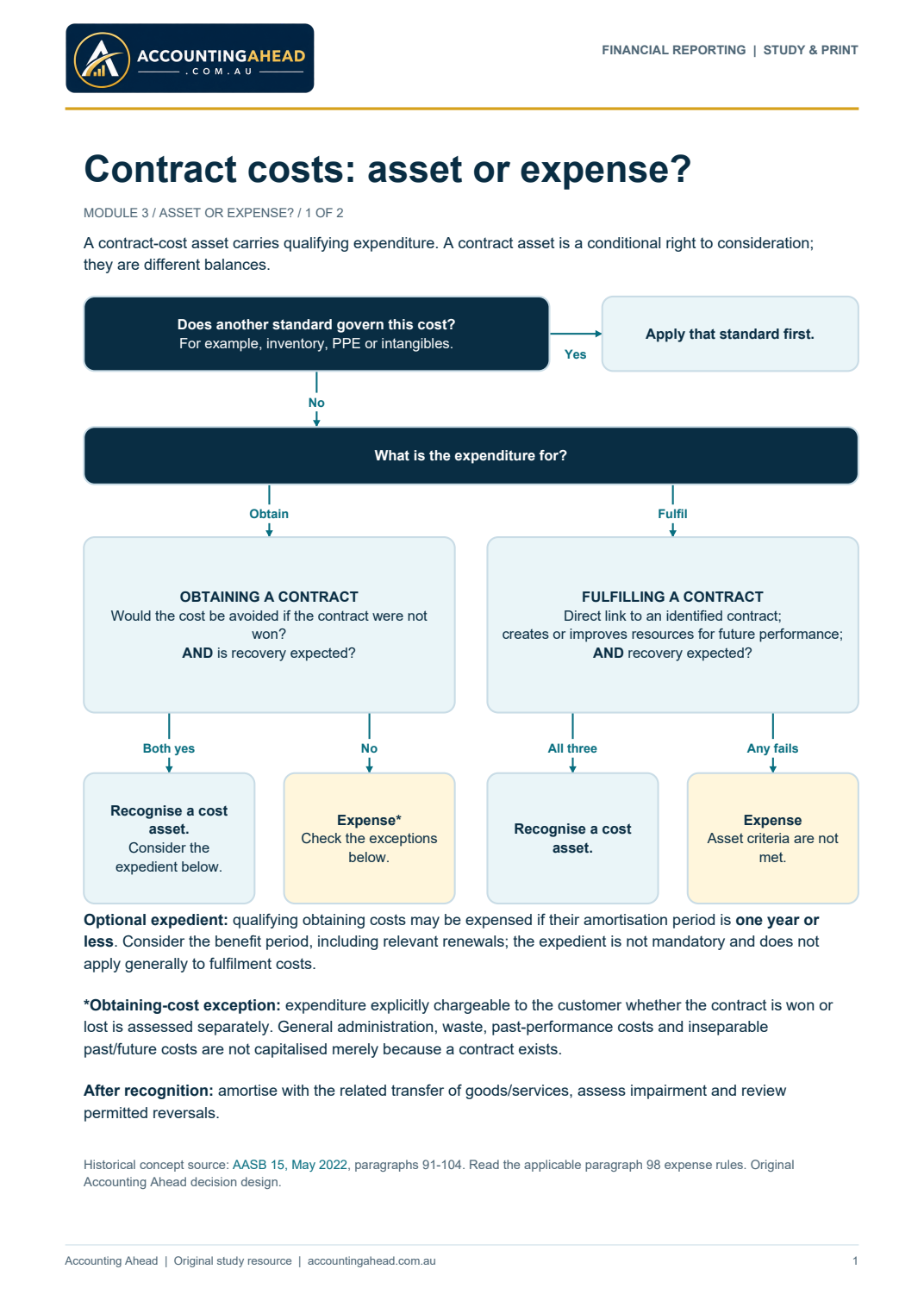
Incremental acquisition costs arise only because a contract is obtained. Recognise an asset when recovery is expected. A success-based sales commission may qualify; ordinary tender travel incurred whether or not a bid succeeds normally does not. Recovery may be through the contract margin rather than a separately labelled reimbursement. The one-year amortisation practical expedient is optional and distinct from the financing expedient.
For fulfilment costs, apply any relevant other standard first. If none governs them, capitalisation under IFRS 15 requires a direct link to an identified contract, resources supporting future performance and expected recovery. Costs of completed performance, abnormal waste and general administration not explicitly chargeable to the customer are not simply parked as a contract asset.
Original cost facts
Treatment, with stated assumptions
$7,200 commission payable only on winning a 24-month service contract; expected to be recovered; no anticipated renewal benefit
Capitalise; amortise with the even service transfer at $300 per month
$1,900 bid-design cost incurred even if unsuccessful; not chargeable to customer
Expense as incurred
$4,800 qualifying mobilisation resource, outside other standards, supporting 24 months of future service
Capitalise if all criteria hold; even transfer gives $200 per month
After six months, the first asset is $5,400 and the second $3,600 before impairment. If a separately assessed cost asset has a $5,400 carrying amount, remaining relevant consideration of $13,000 and directly related remaining costs of $9,000, its recovery benchmark is $4,000 and the impairment is $1,400. This isolated example assumes no other relevant asset impairment and that the specified amounts satisfy the standard's measurement requirements. The impairment calculation adjusts for customer credit risk and uses the standard's specific treatment of variable consideration; it is not merely a copy of constrained revenue.
Follow the obtaining-cost or fulfilment-cost branch before recognising an asset.
Amortise consistently with the related transfer, including anticipated renewals where the asset relates to them. Reassess impairment and permitted reversals; a reversal cannot exceed the carrying amount that would have existed after normal amortisation without the impairment. The contract-cost decision guide and journal sheet provides the sequence.
Disaggregate revenue into categories that help explain its economic drivers. Show opening and closing contract balances, relevant revenue released from opening contract liabilities and revenue relating to earlier performance. Explain when promises are usually satisfied, payment terms, returns and warranties, significant judgements and remaining obligations with expected recognition timing, subject to the standard's practical expedients.
For contract-cost assets, disclose the relevant judgements, amortisation approach, balances, amortisation and impairment. A list of numbers without the assumptions can conceal uncertainty. A note copied from an unrelated business is not an adequate explanation of this entity's contracts.
Use source systems to connect contract approvals, delivery evidence, modifications, allocations and journals. Automated calculations can reduce mechanical errors, but they cannot decide whether a promise is distinct or whether a payment right is enforceable. Review overrides and reconcile the contract subledger to the general ledger.
Concept sources: CPA Australia Financial Reporting study guide, sixth edition (October 2022), Module 3, printed pages 135-142; application features are introduced on page 120. AASB 15, May 2022 compilation, paragraphs 31-45, 91-129 and Appendix B. All examples, entries and practice tasks are original Accounting Ahead material.